


Camping Hygiene: A Forgotten Skill
Most of us live where there’s a sink with hot and cold running water in the kitchen, and a bathroom just down the hall. Doing the dishes takes little effort and no thought at all. Bodily wastes disappear at the touch of a handle and there’s soap and hot water instantly available to wash hands or body.
Amazing to think that indoor plumbing was a novelty just a little over a century ago . . . More amazing to think that much of the world still lives quite comfortably without these amenities.
Camping hygiene probably ranks right up there with bugs, bears and rainstorms among the reasons that more people don’t leave the road and explore. In fact, though many people never say it, I think it ranks #1 (if you’ll pardon the pun). Some of the allure of roadside camping is the toilets, sinks and showers.
Many campers make their first forays in the wilderness to developed campsites which have pit toilets. But, sooner or later, if you play outdoors at all, you are going to get your hands or dishes dirty and need to clean up, or you are going to have to “answer a call of nature” with no plumbing anywhere nearby. Where and how you choose to take care of these needs has an impact on you, the environment, and the people who follow you into the wild.
Camping Hygiene: Distance = Time: Don’t Do Anything Near Water Sources.
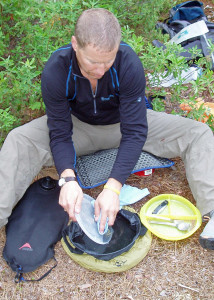
If you are going to wash your hands (or dishes) with soap, and particularly if you are cleaning up after a bowel movement, do not wash your hands directly in a stream or pond. Fill a water bottle or water bag (preferably before you’ve gotten your hands dirty) and carry the water at least 200 feet (more is better) away from any pond or flowing water.
Think of distance from water as time. The more distance your wash water has to filter through soil, the more time there is for the action of natural soil bacteria and natural chemical processes to remove or render harmless the pollutants from the water you used before it contaminates your water source. If everyone followed this simple rule the world would be a better place.
With a little practice, you can get pretty adept at washing your hands very thoroughly using just a tiny drop of liquid soap (Dr. Bronner’s
Lately, we’ve included a nifty item called the Sea to Summit Kitchen Sink
Keeping things clean in the backcountry isn’t that hard. So don’t let personal hygiene fears keep you from exploring.
Camping Hygiene: GOTTA GO!: #1 Rules
By biological standards, urine is pretty clean stuff. Unless you have a bladder infection, it’s sterile and the chemical components are quickly and easily recycled by nature.
Guys, just step well away from the nearest water source and let fly with a clear conscience.
Girls, yes, things are a little more complicated for you. Same rules about water sources apply, and if you use toilet paper, please don’t just leave it lying around. It doesn’t disintegrate nearly as fast as you hope. You have four options regarding tp: 1) learn to do without; 2) bury it at least 6 inches deep (but squirrels may still dig it up to get the salt); 3) burn it (which could start a forest fire if you’re not careful); or 4) carry a separate plastic bag with you and carry it (and any other sanitary supplies) out. Option 4 is obviously the best choice.
Camping Hygiene: GOTTA GO!: #2 Rules
If you can find a copy, read the wonderfully funny, practical and sensible book by Kathleen Meyer called “How to Shit in the Woods: An Environmentally Sound Approach to a Lost Art
Again, no going near a water source!
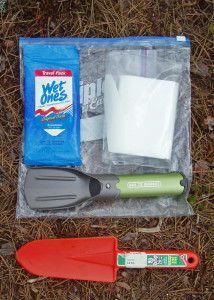
Make yourself a kit in a locking plastic bag. Include toilet paper, biodegradable baby wipes, hand sanitizer, a small lighter (for burning the toilet paper if it’s safe to do so) and a trowel for digging a “cat” hole.
The trowel is handy because sticks usually break and the heel of your boot won’t get deep enough. There are three types of trowels on the market: the inexpensive plastic ones like the Coghlan’s Backpackers Trowel


Dig your cat hole about 6-8 inches deep, squat (I find it easier to hold onto a small tree in front of me for balance rather than trying to lean back against a larger tree) and do what you need to do (don’t miss the hole!). Clean up, burn the tp if you can do so safely, and cover whatever’s left with the soil you took from the hole, tamping it down firmly and spread leaves over the top to camouflage.
That’s it—you’re good to go without doing any harm to the environment or offending anyone who follows you into the wild.
Camping Hygiene: Poo Packing
In some places (island camping for example,) you simply have to pack everything out, including your bodily wastes. In situations like this, “Wag Bags” like the Cleanwaste Toilet in a Bag Toilet Kit 
Or you can try the “Crap Wrap Poo Packing” technique which is a standard for kayak campers:
1) Add some newspapers to your basic hygiene kit.
2) When you have to go, spread several layers of newspaper (usually two or three sheets) flat on the ground and aim for the center.
3) When you are done, wrap up the newspaper neatly, and double bag it in tightly sealed plastic bags, preferably the Biodegradable Waste Bags
4) Carry it back to civilization and dispose of it properly.
Sounds distasteful, but it really isn’t that hard to do, and it’s a small price to pay for a pristine environment.