


Let’s just assume, for the sake of argument, that you’re going camping and it’s going to rain. Pretty safe assumption in many parts of the country most years. Where I live, it rained often last summer and the summer before that. You can, of course, hope for dry weather, but it’s best to plan that it’s going to rain at least part of the time.
You could decide not to go—which wouldn’t be any fun at all. Or, you could pretend it isn’t going to rain, get totally soaked and live with it—which also doesn’t sound like much fun.
Believe it or not, some rain can actually add to the pleasure of camping. There’s something absolutely decadent about snuggling down in a dry sleeping bag in a watertight shelter listening to rain falling.
Here are a couple of tricks for enjoying camping in the rain.
Rain Camping Tips; Pack Right
Just as you dress in layers to stay comfortable in bad weather, you have to pack in layers to keep dry. Any one layer of protection can fail, so double or even triple up.
Pack anything you absolutely need to keep dry—sleeping bag, clothing, food, GPS, in the dry bags originally designed for canoeing and kayaking. There are lots of good ones on the market; I like the siliconized Cordura Ultra-Sil Dry Sacks from Sea to Summit. Never had one fail.
Even though it’s probably made of waterproof material, your backpack isn’t waterproof. It has too many seams and openings. So if you want all the contents to stay dry, you have to use either a pack rain cover, a waterproof pack liner, or better yet, both. I’ve used pack covers from REI and they worked great, but the siliconized nylon pack covers from Sea to Summit are lighter and more compact when they aren’t deployed to cover your pack.
Heavy duty trash bags make pretty good pack liners—but water always seems to find its way into that big top opening, so I’ve switched to a huge Sea to Summit Ultra-sil pack liner with a roll-down top that seals completely. It keeps everything dry no matter what. Get one that completely fills the main pocket of your pack.
Rain Camping Tips: Setting Up A Dry Camp
Especially if you use a pack cover, your gear is most vulnerable to getting wet when you take it out. Tents, in particular, have a nasty habit of collecting a lot of water inside as you set them up. So here’s the real trick to setting up a dry camp even in a downpour:
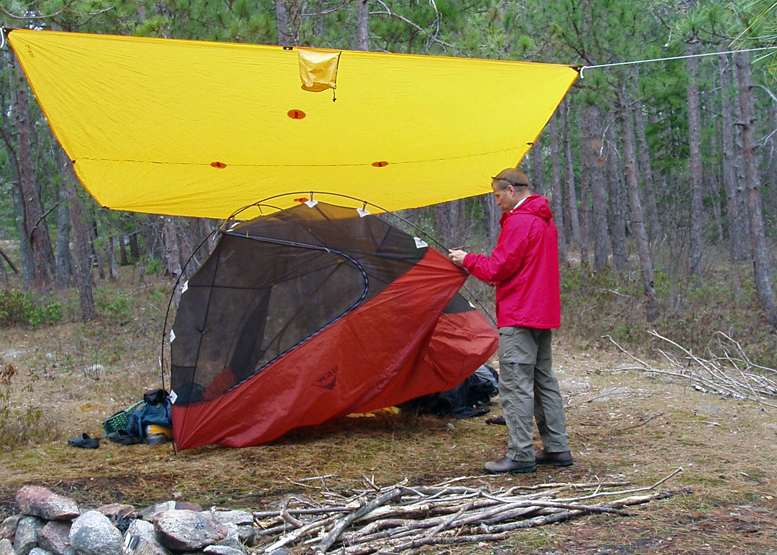
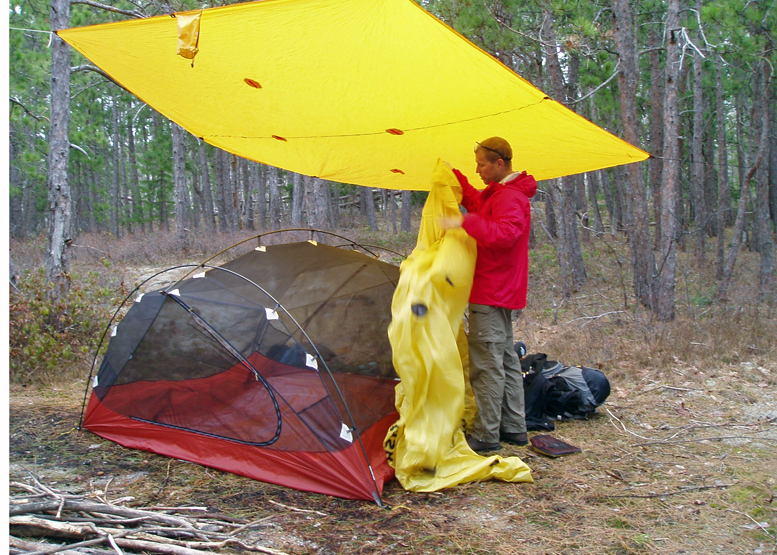
On the outside of your pack, somewhere easily accessible carry a large lightweight tarp and lots of nylon cord. Bigger is better and the new ultralight siliconized tarps are perfect. When I get to my campsite, I lean my pack against a a tree (so the pack cover still protects it, and grab the tarp. I then choose the spot to set my tent and hang the tarp directly over it, trying to pitch it so the water runs off to the downhill side. With enough cord, it’s almost always possible . . .
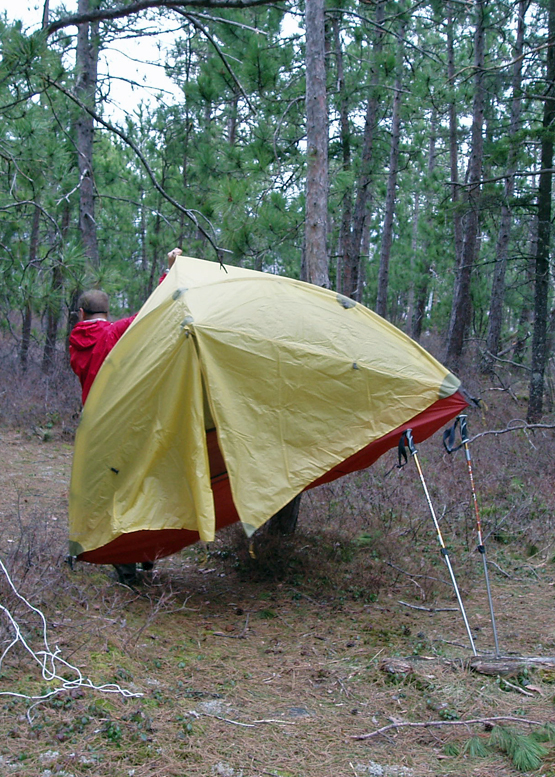
Then, I carry my pack under the shelter of the tarp before I open it and the packliner in it. I set up my tent and rainfly under the tarp, so the tent’s interior stays dry. Some tents can be pitched so the fly goes up first, then you add the tent body—nifty trick if you have someplace to keep the tent body dry while you pitch the rain fly and for added protection if the wind blows rain under the tarp.
If it’s raining in the morning when you strike camp, do everything in reverse order, taking down the tarp only after your still-dry tent and contents are safely stowed. Using this system you can keep your gear dry even through an extended rain. The wet tarp and wet tent fly add weight, of course, but it’s lighter than a pack full of rain-soaked gear.
Rain Camping Tips: Hard Top Options
Extended rainy weather makes hard-top camping a really appealing option. Throughout the hills of New England you can find cabins, lean-tos huts and yurts, all of which allow you to camp out without having to worry (much) about the rain. You do still have to worry about mosquitoes . . .
The Appalachian Mountain Club, has a system of high huts in the White Mountains, which are perfect options for an overnight, whether it’s raining or not. If you’ve never been backpacking, this is a great way to start since you don’t have to worry about shelter or food. Their cabins such as High Cabin on Cardigan Mountain in New Hampshire and Goose Pond Camp in Mass., are another option.

There’s also a new system of 12 hike-to huts being developed by Maine Huts. Three have been completed so far with more coming.
The lean-tos and shelters along the Appalachian Trail in CT, MA and NH and Vermont’s Long Trail are often crowded in the summer, though that may not be the case when it seems to rain constantly. Mid-week is an especially wonderful time to go and explore.
The Randolph Mountain Club has four shelters: Gray Knob, Crag Camp, The Log Cabin and The Perch, with bunks available on a first-come, first-served basis
The White Mountain National Forest (www.fs.fed.us/r9/forests/white_mountain/recreation/camping) has lean-to shelters in some backcountry campsites and several hike-to cabins, some of which can be reserved. Download their “On Foot” brochure for an (almost) complete listing.
Merck Forest & Farmland Center (www.merckforest.org) in Rupert, VT has several cabins that are perfect for a rainy-night getaway.
The Adirondacks of New York has over 200 leans tos scattered about the landscape. You can find a list here on the Central New York Hiking website..