


This magazine is all about being active outdoors, trying new things in new places, AND doing it safely. There’s absolutely no reason to take unnecessary risks to enjoy outdoor adventures. Generally, it’s the people who don’t consider their own abilities and limitations within a situation who get into the most trouble. But, sometimes, trouble comes to find you, even if you’ve done your best to avoid it. People get hurt in their homes and on city streets, too, but there are usually more resources readily available to help. In the woods, it’s sometimes up to you.
If trouble comes to find you and there’s no one else to help, are you prepared? Do you know what to do?
Let’s Play An Imagination Game . . .
You and some friends have rented the only cottage on an idyllic island not far off the Maine coast for a late-season weekend getaway. No access except by small boat (you came by sea kayak), no cell phone or wifi, total relaxation. Sounds wonderful, doesn’t it? You have plenty of food, the cottage has a cistern full of fresh water, a wood stove and plenty of wood. The Maine Island Trail maintains a campsite on the far end of the island, but, as far as you know, you are the only people on the island.

The weather was perfect when you paddled out here yesterday. You’d watched the forecasts and had gotten settled in well before a predicted storm. By the time you are ready to leave, all should be calm again. But it’s a nasty, cold afternoon: screaming winds, pouring rain, low clouds and fog, crashing surf, it’s getting dark fast. . . . and you are inside by the fire, snug, warm, and happy.
Suddenly, a specter appears at your door with blood gushing down his face, begging for help. Five friends out kayaking took shelter on the island, and set up their camp to wait out the storm. But the wind has been fierce and a large tree has crashed over onto their tents, injuring them all. Despite all the blood, he’s the least hurt, the only one who could go for help.
When you arrive at the scene, two are still pinned under the tree. One of these has a broken thighbone sticking out through an open wound, one is unconscious. Two other campers are badly hurt. One has a broken branch driven through his hand. The other is clearly in shock. If you don’t stop the bleeding and stabilize the injuries, more could go into shock soon. To make matters worse, it’s cold and wet and getting dark. If you don’t get these victims dry and warm quickly, someone could well die of hypothermia before morning.
There’s no way to call for help. All you have is what’s already on the island and what you know. . . .
Practice Before You Need it

In a situation like this, would you be able to formulate a plan, aid the injured and move them to greater safety? I suspect for most of us, the answer is no, not really. It’s one thing to fantasize playing superhero, quite something else to deal with twisted bodies and blood in the rain and dark, where you can’t just call 911 and make it go away.
The scenario described above was our “final exam” in a two-day Wilderness First Aid (WFA) course at Mahoosuc Mountain Lodge in Newry, Maine. Our instructor was Jon Tierney of Wilderness Medical Associates, one of the premier providers of wilderness medical training in the world. Jon is a critical-care paramedic with LifeFlight of Maine, an internationally certified mountain guide and the owner/head honcho of Acadia Mountain Guides) one of the top climbing schools/mountain guide services here in the northeast.

One of the things that attracted me, personally, to the course in the first place was the way it was structured. I shudder at the thought of spending time in a classroom, especially in late October, one of the most beautiful times of year to be outdoors. But the course description promised “You should expect to be outside regardless of the weather; working on your hands and knees,in the mud, if it rains (actually, it snowed) and carrying loaded litters over rough terrain and through brush. For your own personal safety and comfort, please dress appropriately.” In other words, this was a class for people who like to be doing things outdoors.
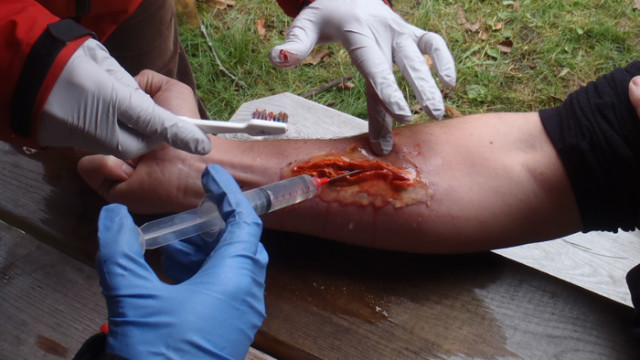
All weekend long, we alternated quick, thorough, informative classroom lectures with outdoor practice on startlingly realistic scenes you might encounter if you travel in the wild. Jon brings enough gruesome wounds and fake blood in his kit to make an entire class of fourth-grade boys happy at Halloween. We dealt with everything from mild hypothermia, slips and sprained ankles to insulin and anaphylactic shock, broken limbs, possible heart attacks, and spinal injuries. We learned the latest CPR techniques, learned how to give a shot if we needed to, made splints, bandages and litters from materials at hand (think MacGyver), all while keeping people alive in cold, wet, windy conditions. Then, we put it all together as a group in the “final exam” outlined above.
Was it perfect practice? Of course not. For one thing, nobody was going to die if we did something wrong, which made it easier to relax and focus. Also, most of our victims were conscious (which makes a HUGE difference), and were polite enough not to scream uncontrollably or spurt blood on us from open wounds or compound fractures.

Still, the “accidents” looked pretty darned realistic and we learned that you almost always have more time than you think. In fact, we learned over and over that your best immediate response in an emergency is usually to “STOP” (Slow down, Think, Observe, Plan). Don’t plunge in without thinking through your priorities and options. And don’t put yourself at risk to try to help others. You might well make matters worse, not better. If you become part of the problem, you can’t be the solution.
We learned to evaluate the patient not just for obvious injury but also for hidden problems and long-term trends. We learned to inventory the resources at hand and use them wisely; to assess each situation to decide if it was serious or not serious, urgent or not urgent, stable or unstable. We learned not to get behind on the basics of keeping the victim (and ourselves) as warm, dry, fed, rested, and upbeat as possible. All good lessons to remember in any “situation,” large or small.
Ideal to Real
The classroom training and hands-on practice we experienced in this Wilderness First Aid course was designed to help make the transition from ideal to real. When someone is severely injured in the backcountry, “ideal” is a helicopter with paramedics dropping in to save the day. But that can’t always, or even often, happen. Some people think a cell phone can solve any problem, but it can’t if there’s no battery or signal, or if the weather or terrain are so bad that rescue can’t reach you. Or if you are lost and the rescuers can’t find you. Sometimes, it’s up to you and the resources you have at hand.

It’s what you do with the “real” that can make things better and save lives. A big part of our weekend was learning to do the best we could with what we had available, to make a plan and keep moving forward, dealing with problems one at a time as they arose. Even in these make-believe situations, it would be easy to panic and freeze when faced with most of the injuries or illnesses we encountered. Training helps you to keep moving effectively to solve the problems one at a time.
This is more than just first aid training, of course. The critical thinking, assessing, planning and creative problem solving skills we learned in this Wilderness First Aid course are what you need to take with you every time you leave the road. In the outdoors as anywhere in life, things can go wrong any time, anywhere.

With each practice scene in this Wilderness First Aid course, we got incrementally more confident and competent. None of us are ready to do surgery. But, because we took this course, we are all carrying more knowledge, experience, and skills in that most-essential emergency kit—the one we carry between our ears.
Over the last five decades of outdoor adventuring, I’ve encountered and helped deal with dozens of minor bumps, bruises, cuts, and blisters, plus several major traumas including a bad gash, broken bones, hypothermia and even a heart attack. Before this course, it had been almost 40 years since I took a first-aid course. I was more than due for a refresher, and while I hope I never have to put anything I learned into practice, I’m glad I got it before I really needed it. How about you? Will you be ready if something bad happens?
More Training Options
This Wilderness First Aid (WFA) course started with the basics, and is a great place for you to start if you’ve had no first aid training or if you, like me, have lost the edge on whatever skills you had. Based on what I saw, I think a WFA course is pretty near essential for anyone who travels in the backcountry and wants basic competency in first aid in a remote setting, backcountry emergency procedures and improvisation and evacuation skills. It’s designed to help you, in their words, “develop good assessment and scene leadership and further your risk-benefit decision-making skills, recognize situations you can manage alone and when you need to scream for help. No experience required.”

If you already are certified in Wilderness First Aid, the next step up the ladder is Wilderness Advanced First Aid (WAFA). From there, more course work takes you to Wilderness First Responder (WFR) which is probably most appropriate for outdoor group leaders, but could benefit anyone in an emergency.
WFA, WAFA, and WFR Instruction Sources in the Northeast
Note: Each of these companies offer their courses in a number of venues.
Wilderness Medical Associates International
SOLO (Stonehearth Open Learning Opportunities)
National Outdoor Leadership School
Sirius Wilderness Medicine (offers courses in both English and french in Ontario and Quebec.)