

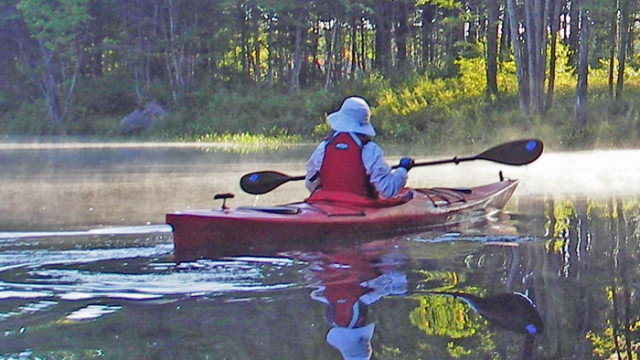
Reservoir Recreation: Finding Perfect Places To Paddle
What’s a perfect place to paddle a kayak for you? It seems to me that you are either a people person or you aren’t. I’m mostly not.
Some folks love to paddle along settled shorelines. That has it’s appeal, I suppose. But I prefer seeing trees, not lawns and houses, wildlife, not people. And I especially like places with little or no motorboat traffic.
I’m not talking about big adventures. I’d love to paddle a kayak along the coast of Labrador or Greenland, but that’s only a dream. I’m talking about places where you can paddle in the evening after work or on a sunny weekend morning before you have to run errands
My sweetheart Marilyn, who has only recently discovered the joys of paddling also prefers secluded. But secluded is sometimes hard to find. We can’t drive many hours every time we want to enjoy a quiet hour or two of paddling.
Fortunately we’ve discovered quiet places close to our home on flood control lakes maintained by the Army Corps of Engineers. Here in New England, most of our towns and cities grew up along the banks of rivers. Rivers are subject to flooding and many towns were regularly inundated until the Corps of Engineers built flood control dams.
Controlling floods requires space to temporarily store water. In the typical flood-control project there’s a BIG dam holding back a small pond or lake. Since the surrounding land is periodically flooded, it can’t be developed–which creates some of the most beautiful, unspoiled shorelines you can imagine. 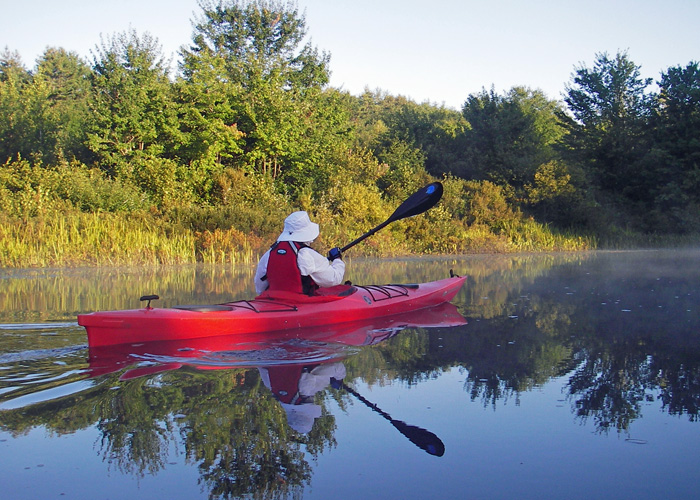
Moreover, most Corps projects actively manage habitat for wildlife—which makes them ideal places for birding and wildlife viewing from a kayak spring and summer, and fall.
On a perfect late-summer Sunday this past Labor Day Weekend, with the air crisp and the sky a bright blue, Marilyn and I launched our boats on a flood control pond not far from our home. The morning mist was still hanging heavily in the air and the only other people around were a few bass fishermen probing the lilly pads for largemouths. We could hear them talking quietly long before we could see them through the mists.
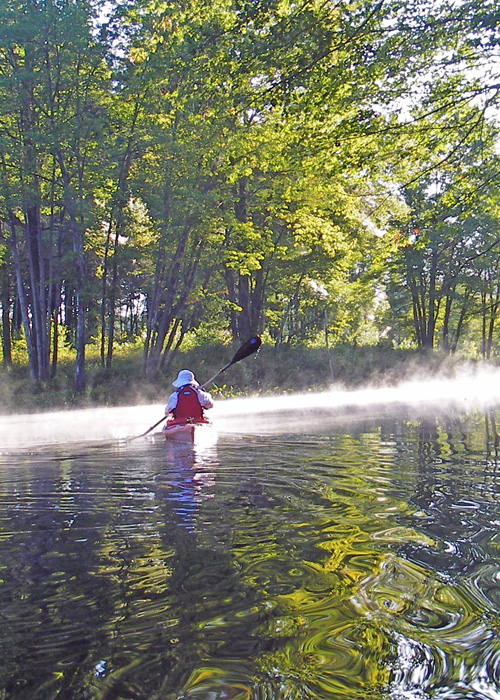
This particular impoundment has five permanent ponds, interconnected by marshes and flat stretches of river that wind beneath a canopy of tree limbs. Once we got away from the voices of the anglers on the ponds and into the narrow, shallow channel of the old river, we might as well been a thousand miles from the nearest person.
At one point Marilyn rounded a tree that had recently fallen over with its top in the water. There were leaves still on the branches, and they must have hidden her approach, because she startled a Great Blue Heron that was no more than 30 feet away when it flapped into the air. A little while later we saw a flock of ducks pass overhead at tree-top height. On previous paddles we’ve seen beavers, otters and muskrats in the water and I once watched a fox hunting along the shore. You don’t usually get up close and personal with wildlife on more developed ponds.
The best way to find Corps projects to paddle is to visit their website, where all the sites are listed in detail. Some have permanent ponds, others are flooded only after heavy rains. Paddling among the treetops is a special treat. If there’s a flood control project anywhere near you, I can almost guarantee it’ll be worth exploring in a kayak. Life isn’t a spectator sport. Get out and enjoy!
Reservoir Recreation: Paddling On The Drink
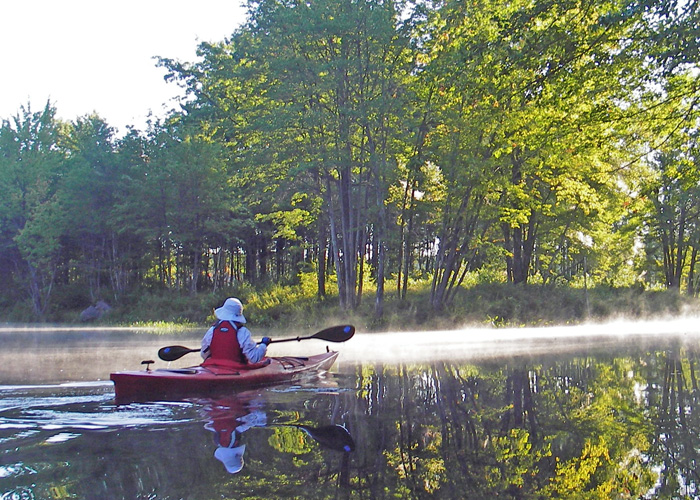
Another great resource for ponds with undeveloped shorelines is public water supply reservoirs. Some are strictly off limits to boaters of all sorts. Others, like the huge Quabbin reservoir in central Massachusetts have very tight restrictions that prohibit using your own kayak or canoe (though you can rent).
Others, such as lovely Massabesic Lake, the water supply for Manchester NH, allow canoeing and kayaking. Massabesic’s regulations allow paddlesports but prohibit windsurfing and other sports which “makes extensive bodily contact with the water unavoidable.”
The same regulations that prohibit swimming and such on public water supplies also protect the shorelines from development. The shorelines of these ponds are often pristine and beautiful, making them perfect places for a quiet paddle.
I just read your article about kayaking on flood control waters. I recently went on Black Rock Lake 1/2 mile from my house after it was flooded. It was so beautiful, not one person to be seen. Beavers curiously followed me as I paddled along tree tops as they were enjoying the tasty tips of trees, not usually a possibility. Paddling over the guard rails of the road below me was almost a little eerie! I enjoy your articles and just finding this website is sure to inspire me to keep on enjoying nature .