

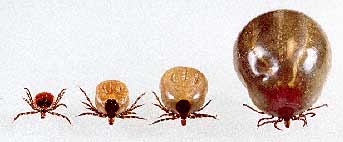

Ask any dog owner: it’s been a horrible year for ticks already. But that’s the new normal: ticks by the billions in places where ticks were once rare.
Here in the northeast (and pretty much across the country) you encounter ticks in two basic styles–both of them bad. Big brown dog ticks are nasty critters. If they latch onto you, the bite site can get infected easily. Not fun. And they can carry Rocky Mountain Spotted Fever, Anaplasmosis, Babesiosis and several other ailments. Also no fun. But at least dog ticks are big enough for you to see them easily.
Ixodes deer ticks (also called black-legged ticks) are even worse. So tiny in their nymphal stages that you can barely see them, they can carry Lyme disease, which you DON’T want to get. There used to be a vaccine available for Lyme disease but it was pulled from the market a number of years ago and the CDC now warns that those who were vaccinated can no longer count on being immune since boosters are no longer available. There are, apparently, new Lyme Disease vaccines in testing stages, but they aren’t yet available to the general public.
The CDC also maintains a complete list of tick-borne diseases in the US.
Six Easy Steps to Keep Ticks Away
These simple steps can help you keep ticks away to avoid tick bites and tick-borne diseases.
1) Wear protective clothing to keep ticks away. Especially important are long pants, which should be tucked into high socks. Ticks generally latch on to a passing critter (you!) and crawl up, looking for a spot to burrow in and feed. Light colors will help you spot the ticks. A couple of years ago, in what wasn’t even a “bad” year for ticks, I took a short hike that passed through a brushy field and found nine brown dog ticks on my light gray socks when I got back to the car.
2) Use a DEET-based insect repellent to keep ticks away around your ankles, wrists (preferably with a light-colored, long-sleeve shirt) and on your neck. Put repellent on your clothing at the entry points (aerosol or pump sprays are best for this), not just on your skin. Caution: This may discolor some clothing, so if you care about looking chic, you may want to change clothes. Our favorite repellent after years of testing is 3M Ultrathon; it stays on longer when you’re hot and sweaty than anything else we’ve ever tried. Sad to say, none of the “natural” (non-Deet) products we’ve tried seem to actually work. If you choose not to use a DEET-based repellent, be extra careful with protective clothing.
3) Leave Ticks Out. If you can do so without getting arrested, disrobe outside your house or your tent when returning from an outdoor adventure, to avoid bringing ticks in with you. Put your potentially-ticky clothing in a plastic bag (perhaps with a spritz of insecticide) and seal it until you can wash it. Some experts recommend putting your clothes in the drier on high heat for 30 minutes to desiccate and kill any hitchhiking ticks before washing–just be careful that no ticks drop off before you get the clothes in the dryer.
4) Check yourself carefully at the end of any outdoor adventure (even a stroll across your lawn). It takes awhile for an embedded tick to transmit disease and a tick check should be as much a part of your daily routine as brushing your teeth before bed. If you don’t have a companion to help, carry a mirror to examine spots you can’t see easily. Remember the “National Geographic” videos with chimpanzees grooming each other? Yes, they’re removing ticks, lice, etc…feel free to make appropriate chimp noises while helping someone do their tick check.
5) Carefully remove any ticks you find by pulling gently with tweezers or using any one of the myriad tick pullers on the market. We’ve had excellent results with the Ticked Off; it puts pressure on the skin and allows you to push the tick up and out. Killing ticks can be difficult; they’re remarkably well armored. Best bets are to flush them, or, if you are regularly in tick territory, to carry a little bottle with rubbing alcohol in it…just drop the ticks in, put the cover back on, you’re done.
6) If all else fails, and a tick attaches, don’t panic; it takes 24 hours for any disease to be released into you. After you remove the tick, take a pen, draw a circle around the bite, and monitor it for changes. See your doctor immediately as a precaution, but especially if you develop any disease symptoms like swelling, fever, a rash, etc.

Tick-Proof Clothing To Keep Ticks Away.
Any clothing makes an effective tick barrier, especially if used in conjunction with a DEET-based repellent. Ticks can’t bite through clothes, they must get directly onto your skin.
Insect Shield clothing from a number of manufacturers has Permethrin bonded into the fabric, and is EPA-approved. It appears to work extremely well against ticks, mosquitoes and blackflies. We’ve been testing it for a couple of years now in pants and shirts from Ex Officio,plus low gaiters and hats from Outdoor Research , and we recommend it highly. It’s rated to be effective for 70 washings; unless you’re detail oriented enough to count, plan on a couple of seasons of effectiveness for moderate use.
We’ve also been testing some ultra lightweight, ultra breathable, snug-fitting long underwear called “RYNOSKINS ” which were developed for the military in hot, humid, bug-infested environments. These also keep blackflies, chiggers, and no-see-ums at bay, but don’t protect against mosquitoes. So far, Rynoskins appear to work very, very well. It’s comfortable to wear (except in real heat and humidity when nothing is comfortable) and we haven’t had a tick (or blackfly) penetrate the defense yet. This stuff fits quite snugly, ticks can’t bite through it and can’t crawl under it to reach the succulent flesh (that would be you and me) beneath.
If you are traveling where there are ticks and blackflies and mosquitoes, a full mesh suit like the ones from Bug Baffler are a great shoice–and they are now making a light-colored version which makes it easier to spot ticks. The full suits from The Original Bug Shirt Company are more durable and also excellent, though they are hotter in warm weather.
Ticks and Color: Does Choosing The Right Color Help Keep Ticks Away?
On a recent kayak camping trip to what turned out to be a tick-infested island, one of us had a yellow tent and found several ticks crawling on it; another had a green tent and found no ticks on it. Both tents were set up only a couple of feet apart, both in the middle of a weedy opening with the river on one side, dense honeysuckle on the other three sides. Tick heaven, apparently.
One of us has a yellow rain jacket and found several ticks on it while the other had a green rain jacket and found none.
Now it may be that the ticks were simply easier to spot on the brighter yellow, but we don’t think so–we both checked the green very carefully. Obviously, more observation is needed. The interesting fact here is that ticks are blind and can’t see color. But it may be that they are still able to sense and are attracted to one color over another (maybe the way a certain color absorbs and radiates heat?). If you have found ticks attracted to one color over another, please send an email or leave a comment below (several people already have) and tell us of your experience.
Perhaps the most useful takeaway on this one is that paying attention to details like this makes it that much more likely you’ll notice the ticks before they latch onto YOU!
Stay Vigilant To Keep Ticks Away!
Sad to say, ticks are out there lurking by the billions, just waiting for a chance to hitch a free ride and a meal, perhaps leaving you a little “gift” of a lifetime debilitating illness. Don’t let that stop you from going outdoors, but do stay vigilant and take simple, basic precautions to avoid problems.
For more information on ticks and Lyme Disease go to www.tickinfo.com and the Lyme Disease Foundation.