


For long days of hiking, there’s nothing like the feel of a top-quality full-grain leather boot. Support, breathability, and the way they mold to your feet…after hours and miles with a heavy pack, you always congratulate yourself for having bought them in the first place.
But, when you bought them, they didn’t feel that way. They were stiff and difficult to work with. Only over time did they become part of you. Boots are one of the few things that we don’t enjoy replacing; no matter how good a new version is, it’s hard to give up that perfect feel of a well-worn pair.
So, how to make them last as long as possible? The reality is that maintaining your boots is a relatively painless process, with a bonus; when you’re done, they not only are going to last longer, they look better. Pride of ownership is a wonderful thing!
Here’s how we do it:

1. Take the laces out. Check them over; if they’re frayed, replace them. It’s easier to do that than have to fix them when they break 10 miles out in the middle of nowhere.
2. Clean the boot fully. If there are gaps between the sole and the leather, use a small screwdriver, a toothpick, whatever fits to scrape out the gunk that’s gotten in there. After that, use a good leather cleaner to make sure the boot is prepared to accept the waterproofing. We use Granger’s G-Max Gel Cleaner; it’s easy, doesn’t make an awful mess or soak the boot through, and is designed specifically for the purpose. For the areas where the rubber and sole have separated, use q-tips and rubbing alcohol to get them ready for re-glueing.
3. Once the boot has fully dried (if you have a boot dryer, like the DryGuy DG-1, use it; that way, when the boot looks dry, you know it’s dry from the inside out, making sure that glue and waterproofing work as well as possible), do any sole repairs. If your boot has a rand, or protective rubber strip, that has separated, glue it back in place. If it has an extended sole like my L.L. Bean Gore-Tex Crestas, don’t try that; they’ll just separate again. Instead, fill the gap with your repair material using a toothpick, then smooth the transition with a popsicle stick. We use McNett Freesole for that type of repair; it’s easy to use, sticks to everything, and is durable and flexible in all conditions. McNett has excellent instructions on their website for this and other types of repairs (they specialize in repair kits for boots, tents, backpacks, etc.). If you need tape to hold the rand in place, there’s a number that you can use, but we like the blue tape used for masking when painting; it sticks remarkably well, but doesn’t leave any gunk behind that would need to be cleaned off later.
4. Once you’ve completed repairs to the rubber and the material has fully cured, it’s time to apply the waterproofing. We’ve tried every one we’ve run across, and Granger’s Paste Wax is the best and easiest to use, as it lasts even after it has worn off the surface and doesn’t seem to affect the breathability of the Gore-Tex membrane. Work it in with a cloth or your fingers; we prefer fingers, as body temperatures melt it and help it soak into the leather. Get it into all of the little crevices around eyelets, etc; any area you miss will be susceptible to leakage and cracking of the leather.

- Transformed from ugly to almost new, these boots will continue to perform in rotten conditions (David Shedd photo)
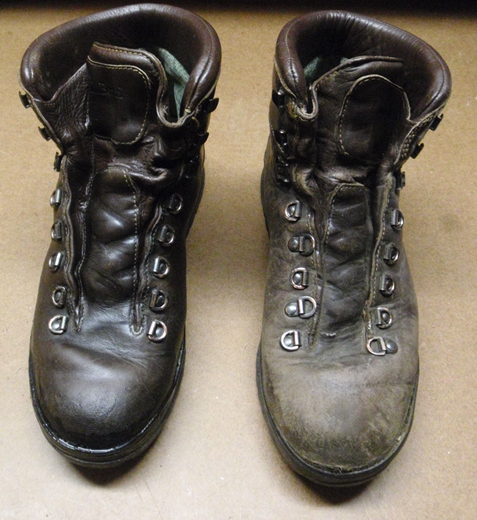
5. Sit back, look at your lovely, shiny boots, and plan your next hike!
It really is that easy. The only hard part is the timing; plan on up to three days to complete the work, as you need to give the boots time to dry between steps (a boot dryer obviously speeds that process up, but won’t speed up drying of the Freesole, unless you also buy Cotol-240 accelerator). If you need things to happen faster, use the aids, but don’t short-circuit the process; do it right, and you’ll get better short-term results and longer boot life.