


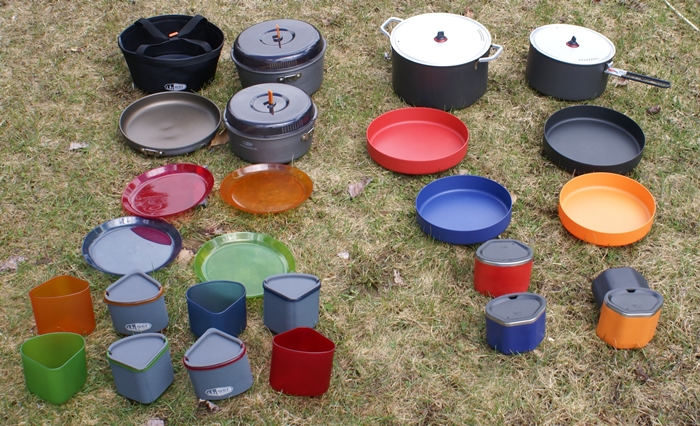
Ultralight camping can be wonderful, but sometimes ease-of-use and organization are more important. Nothing’s more frustrating than hearing “I thought YOU were bringing the big kettle!”, just when you’re ready to boil up a mess of fresh-picked fiddleheads, and there are 4 hungry people waiting for dinner. When it’s just two of us and dinner’s going to be relatively simple, we tend to grab the GSI Dualist; but, are there solutions that make things easy for larger groups?
The answer is a definite yes, and two top options are MSR’s Flex 4 ($160 MSRP) and GSI Outdoors’ Pinnacle Camper ($120). Although significantly different in the details, the concepts are remarkably similar; two large pots, plates, bowls, and insulated mugs, all neatly packaged into a “NOW try to forget something!” combination (okay, you still do have to remember your fork and spoon). With two good options, which one is best?
Turns out that there’s no easy answer to that question. Each has strengths, each has weaknesses, and which you choose depends more on your own needs and preferences than on which is “better” than the other. The good news, cutting to the chase, is that both are functional and well-designed overall; even if you buy the “wrong” one, you’ll have a system that will make your life easy for group trips. So, item-by-item, here’s the breakdown.

Pots- Here’s arguably where the greatest difference between the two systems appears. MSR, true to form, chose to make theirs heavy duty anodized aluminum; durable is their hallmark. GSI, on the other hand, went with a lightweight aluminum with Radiance non-stick coating. With the MSR, you can use any utensils. You could probably also use the big pot to beat a bear that’s trying to break into your tent over the head without damaging it (the pot, not the bear). GSI claims you can use metal utensils with Radiance, but we’re somewhat unconvinced; coatings scratch. However, if you’re relatively careful about your cookware, the GSI offers easier non-stick cooking and cleaning, and somewhat lighter weight due to the thinner metal. The MSR comes in at 3 pounds, 9.6 ounces, vs 3 pounds, 5.4 ounces for the GSI (more on the GSI system weight later, though). If you tend to take a bunch of 13 year old ham-handed Boy Scouts out or camp 100 days a year, better to go for the durability; more careful adults that get out a handful of times a year should get plenty of life out of the GSI.
One other advantage to the MSR–integrated handles. To make the system small and light, GSI went with a folding handle; it works very well, and we have no issues with it…except that word “it”. “They” would be better; if you’re using both pots at the same time, switching the handle from one to the other is a royal pain in the neck.

And, while we’re still on pots, we’ve left out one significant detail. The Pinnacle Camper, unlike the Flex 4, comes with a shallow, light, steep-sided frying pan, as well. Sadly, we found that when we added the handle to it, it was so unstable as to be dangerous. When we contacted GSI Outdoors about that, they said that they really didn’t expect the system to be used by “serious” backpackers; it was designed more for people doing car camping with a big, flat propane stove. Fair enough, particularly as on their website it’s only listed as a car camping product. BUT, this system deserves to be taken out in the woods, and backpackers shouldn’t be excluded from using it. Our recommendation: Leave the frying pan in your garage. You’ll save about 6 ounces of carry weight, and nobody will burn themselves with bacon grease. Personally, we’d love to see GSI replace the frying pan with another handle; the system would work better AND weigh less…maybe they can reconfigure it as a different product aimed more perfectly at backpackers. If, of course, you ARE going car camping and have a more typical propane grill with a large surface for the pan to rest on, take it and enjoy it!

Plates/Bowls– Another fundamental difference between the two systems. MSR offers a single large combination plate/bowl per person; GSI uses smaller plates, with the bowls integrated into the cups (similar to the system in the Dualist). Each version works, but which you choose will depend on your own personal camp cooking style. If you tend toward stews and “glop” meals (a whole bunch of stuff thrown together in one pot), the MSR makes more sense; GSI’s bowls are too small and oddly shaped to handle big meals of that sort on more than a off-and-on basis. If you cook up food that tends to require a knife and fork (chicken fricassee, anyone?), the flatter plates of the GSI are easier to cut on. Anything that you tend to slurp (Ramen noodles, for instance) also will work better in the GSI bowls, as the triangular shape creates a natural funnel.

Mugs– This is probably where the two systems are most similar, with both having relatively tall units that are shaped to fit inside a round pot. Yet even here, the details are substantially different. The MSR is a metal-lined mug covered by a soft plastic insulating layer. With the drinking hole along the rounded side, the cups fit relatively well into either hand. The GSI is a plastic with a neoprene cozy, and drinking spouts at either corner. That’s a handy feature; whether you drink right or left handed, put the curved side of the mug against your hand, and it’s comfortable to hold and sip. Insulating value was identical…we poured 8 ounces of 140 degree tea in both, let it sit in 50 degree weather for 15 minutes, and both measured at 120 degrees. Your choice here; both work, neither are as good as a regular coffee mug. A slight nod goes to the GSI as the metal edges of the MSR tend to get hot, and sometimes the MSR covers were loose and needed to be held on, plus the vent hole to let air in is small enough that it made sipping difficult.
Covers– Both intelligently designed with strainers built in, the variance here is in material and cooking design. MSR went with aluminum, GSI with plastic; we’re neutral , as they both work fine and feel solid with no tendency to break. MSR uses flat covers, GSI’s are domed. Here again, it depends on how you cook; if you want to boil pasta fast, go MSR, but if you want to simmer a savory stew, domed covers circulate the odors and flavors better. For typical backpacking cooking, the difference is minor, at best. We’ll call this one a draw, though the pot cover on the MSR does lock on with snap rollers, making it easier to drain pasta and such.
Form factor– Simply put, the GSI is slightly smaller and fits in backpacks better. If you’ve got REALLY big eaters, you may need a pot as large as the MSR’s, but for most uses the GSI is plenty big. Again, if you boil tons of pasta, go to the MSR; the extra volume allows more water and better texture.

GSI bonus– The one thing that the GSI has that the MSR doesn’t (other than the backpacker-unfriendly frying pan) is the carrying case. As with the Dualist, it’s a waterproof seam-sealed bag that can be used for carrying water or doing dishes. It’s very functional and is a nice touch; we found we could fill it half full and carry it comfortably without any worries about spilling.
And the winner is? The owner…both can make your life a lot easier. If GSI ditched the frying pan and included a second handle, that would be enough to tip the scales entirely in their favor; but as it stands, both do most things as well or better than most of the stuff that most of us own. The GSI is a bargain, the MSR is a beast that’ll outlive you…which kind of camp cook are YOU?