

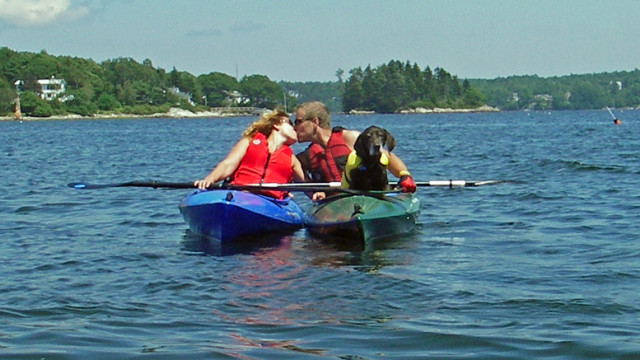

Marybeth from Connecticut wrote asking advice on picking kayaks for her and her husband: “We are looking for something for the lakes near our home in Connecticut, but have an opportunity to kayak on a quiet ocean inlet in Maine where we vacation every summer.”
By knowing where she wants to paddle, Marybeth has made a good start on getting the right boats for her and her husband. She and her husband may actually end up with four kayaks: two for the ocean, two for the ponds. That’s the way it is with kayaks.
There’s no way I would ever recommend a specific kayak for anyone. Kayak preferences are as personal as underwear. But there are some general considerations which can help you find a kayak you can live with happily.
Not all kayaks are created equal. Sadly, there are lots of slow, clunky kayaks that just aren’t much fun to paddle. They are cheap, so people buy them thinking they are getting a bargain. Typically, however, they get used a few times, then abandoned. It’s like trying to pedal a clunker bicycle — despite your best intentions you don’t go far or stay with it. Good equipment makes a difference.
There’s also a safety issue with inexpensive sit-in kayaks. If a kayak doesn’t have either sealed compartments at the ends, or foam blocks or inflated airbags, it will take on so much water if you capsize that you’ll never be able to right it, get back in, get the water out and paddle to shore. Of course you are ALWAYS going to be wearing a PFD when you are in a kayak, but some kayaks should never go far from shore!
So here’s my advice for what it’s worth:
How To Pick A Kayak In Six Easy Steps
1. Know yourself. Only you can pick the right kayak for you. So start with what’s most important to you, Do you want to go far and fast? Or are you content to paddle just far enough out on the quiet pond to see the sunset? Do you want performance from your kayak or are you content to just loaf along? Do you have good balance? Are you agile and strong enough to get into and out of a kayak easily. Do you paddle alone? Are you comfortable in the water or do you want to avoid getting wet at all costs. Do you want to carry camping gear or an elaborate gourmet picnic? Do you want a kayak you can onto a car rack by yourself? Do you want to fish or shoot lots of photos from your kayak?
You also need to feel comfortable fitting in any kayak you choose. Are you S, M, or XXXL? No one wants a boat that’s too small, but some people prefer to feel like they are part of the boat (which enhances performance) while other like to lounge in more spacious comfort.
2. Know where you want to paddle. There’s really no such thing as an all-around kayak. Do you paddle on high-water, turbulent rivers? Gentle-but-rocky rivers? Placid, slow-moving rivers? Ponds and marshes? Small lakes with some motorboat traffic? Big lakes with lots of wind and boat wakes? Protected saltwater bays? The ocean surf? Open ocean? Decide where you want to paddle most and buy the best boat for that. If it works in other situations, great. If not, rent when you need to, or own more than one kayak!
3. Learn A Little About Kayaks. Just some of the basics: Wider boats feel generally feel more stable but longer, narrower kayaks are faster and require less effort to paddle than shorter, wider ones. Shorter kayaks turn more easily (sometimes too easily if your goal is to go in a straight line). A sit-on-top kayak is easy to get into and out of, but doesn’t offer you any protection from cold water or bright sun. A sit-in kayak with a big cockpit is easier to get into and out of, but a smaller, tight-fitting cockpit makes the boat easier to maneuver. Smaller cockpits are also easier to seal with a spray skirt to keep out spray and waves. Bulkheads and hatches make it easier to carry gear, and help keep you boat afloat should you capsize. Everything else equal, molded plastic boats are heavier, more rugged, less expensive than composite or thermoform, but composite and thermoform boats are more efficient to paddle.
4. Narrow Your Choices. Based on Steps 1, 2 and 3, you should be able to narrow your choices. A salesperson at a good paddling shop can then help you begin to focus in on specific boat models.
5. Try as many kayaks as you can before your buy. Rent! Borrow! If someone has a used kayak for sale near you, ask if you can paddle it. Go to a paddling demo or buy from a shop that lets you actually get in the boat and paddle it before you buy.
6. Don’t be afraid of making a mistake. If you buy a boat and eventually find isn’t perfect for you (hint: no boat is ever perfect), don’t despair. There’s a strong market for used kayaks. Just sell it and get another one that suits you better. You’ll know more about yourself and what you want and will be more likely to get it right the second time.
You never just buy a kayak. You also have to buy, at least, a paddle and a PFD (flotation vest). Let’s start with the PFD, since no one should EVER get into a kayak without one. The two criteria you really need to worry about for kayaking are fit and flotation.
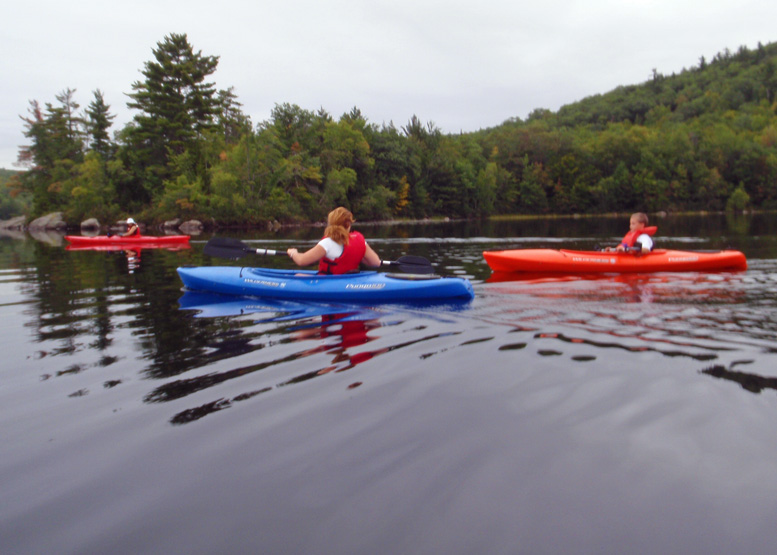
To fit properly, a kayaking vest has to be the right size for you and it has to let you sit comfortably in the seat of your kayak and move your arms in a natural paddling motion. If it pushes up, binds or limits your paddling motion, it doesn’t fit. Women will typically appreciate the anatomic contoured fit of a woman’s vest.
For expert advice on picking the right paddling PFD for you, go here
Kayak paddles come in different lengths for different boats and paddling styles, with different blade shapes for different purposes. One general rule with paddles: all else equal, lighter is better, which is why carbon fiber is the (expensive!) material of choice.
Some paddles have the blades in the same plane, others are “feathered” with one blade offset from the other. Most are adjustable. Most paddles today allow you to adjust the blade offset angle (feathering) to your personal preference. Try different configurations and find what’s right for you.
Sprayskirts
If you are paddling a sit-in kayak where there’s any chance of encountering really turbulent whitewater, a wave or boat wake big enough to wash into the cockpit, you really should have a fitted spray skirt. Personally, I think every sit-in kayak needs a spray skirt—it just makes the boat more versatile. Take paddling in the rain, for instance—it can be a lot of fun and a lot more comfortable with a spray skirt than without. Lot’s of times, you don’t need them, but when you do, you do. I always have one with me in the boat, and if there’s any chance of rough water I have it on (you wear them like a funny-looking skirt, hence the name) and ready to snap into place around the cockpit if the wind, waves or boat wakes kick up. To be effective, a spray skirt needs to fit the boat it’s being used on. In my experience, the fit of Seals sprayskirts is always excellent, and they offer a range of options and prices.
For paddling on quieter waters, a Splash Deck can keep paddle-drips off your legs and protect them from the sun. I don’t own one, but if I did a lot of paddling on ponds and quiet rivers, I sure would.
Rudders and Skegs
A rudder or skeg isn’t always necessary, even on longer boats, but there have been many times you’ll appreciated having one or the other, even though they add cost, weight and complication to your boat. Both can be very handy, especially on big water to keep you tracking straight in the wind and waves. Boats that don’t have a rudder or skeg require more finesse with a paddle. If you want to add a rudder to a kayak you already own, Harmony makes re-fit kits for many popular boats.
Are You Confused Yet?
Don’t be. As we said at the beginning, once you’ve made some basic decisions about where and how you want to paddle, your choices narrow and it’s easier to find the right kayak and start having fun.
Hi, I am a beginner kayaker and I am looking to travel and fish for bluefish and striped bass in the somewhat rough, choppy, and large swells of the Boston Harbor.
I am also looking to mosey along in the lazy waters of the Charles River.
I am 5’8″ 220 lbs. I am wondering if you could possibly reccomend a safe compact kayak that easy easy for one person to manage and carry around that I can use to fish and travel to and around the Harbor islands that will also do the river?
Thank you very much!
Could you possibly note 1st 2nd and 3rd choice out of the following.
I have been looking at used Ocean Kayak brand:
Scrambler XT
Scrambler 11
Tetra 12
Trident 11
Field and Stream Eagle Talon 12
Pelican icon 10
Any help appreciated and thank you again
Chris,
I’m not personally familiar with any of the kayaks you mentioned, so can’t make a specific recommendation. Besides, as I said above, kayaks are as personal as underwear–what’s right for me isn’t necessarily going to be right for you. But I can give you some parameters which will help you focus in on the right boat for you.
First, since fishing is the first thing you mention, I’d focus on fishing-specific models. Otherwise, you are going to have to kluge on rod holders, and spots for other gear. These folks have already put a lot of thought into solving those issues. Why waste time re-inventing the wheel when you could be out paddling?
Before you start thinking specific model, think about the basics.
Length: The longer a kayak is relative to its width, the farther and faster it goes with less effort. Also, longer kayaks tend to be more comfortable in rough waters. The tradeoff here is that longer kayaks are heavier, and plastic Sit On Tops (SOTs) tend to be the heaviest of all. So it becomes a matter of how much weight you feel you can handle alone. Only you can decide that. Spend some time thinking about how you are going to transport your boat. You can get away with a heavier boat if you are pulling it on a trailer than you can if you are lifting it onto a tall SUV (though Malone, Yakima and Thule all make aids that can help with that chore). Finally, think about where you are going to store your boat. That may affect the length you choose.
Without really knowing you, I’m going to suggest that you’ll probably want a boat between 12 and 14 feet. A 10-footer is too small for Boston Harbor, won’t have the cargo capacity you’ll want for fishing. Anything over 14 feet may get too heavy to handle alone.
Width isn’t much of an issue, since all these models will be between 28 and 30 inches + -. You need the width for stability while fishing, but you’ll pay a price in terms of paddling performance and rough-water comfort (narrower boats are actually more comfortable in waves–which I know sounds counter-intuitive.)
Rudder: a rudder is a two-edged sword on a fishing kayak. It helps with tracking and stability in wind and waves and makes paddling nicer, but gives you one more contraption on which to catch your lines . . .
The nice thing about buying a kayak is you really can’t make a mistake. They hold their resale value well and you can always sell it. But premium brands like Ocean Kayak, Cobra, Native, Freedom Hawk, and Wilderness Systems tend to hold their value better and are easier to re-sell than a mass-market store brand like Field & Stream or Perception Sport.
Of the boats you mentioned, I’d probably focus on the Ocean Kayak Tetra 12 and use that as my base of comparison. But I’d also try an Ocean Kayak Trident Ultra 4.3 —14-feet and only 4 lbs. heavier—to see if you like a longer boat.
If you can paddle before you buy, that’s always best. Then compare feel and features on other brands and models. The reviews at Paddling.net http://www.paddling.net/Reviews/Kayaks.html are a tremendous resource.
I hope this helps. If you have any more questions, feel free to ask. Oh, and please let us know which kayak you buy and how you like it.
Two more thoughts:
1) be sure to read this story before buying a paddle: http://easternslopes.com/2012/05/01/expert-advice-on-selecting-the-right-kayak-paddle-for-you-and-your-boat/
2) and this story before you buy a PFD. (Which, we hope, you’ll always wear because we want you around to read more stories and ask more questions) http://easternslopes.com/2013/08/04/how-to-expert-advice-on-picking-the-perfect-paddling-pfd/
Tim