

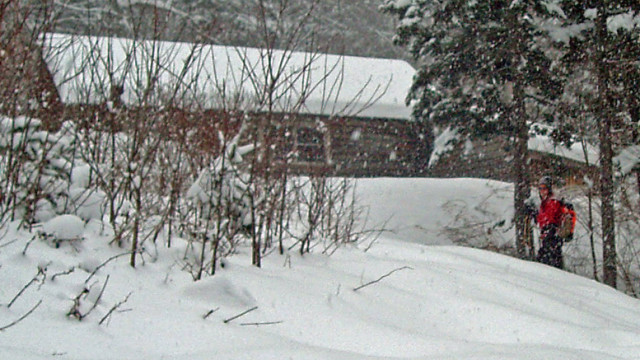
Three rules for having fun outdoors in winter:
1) Snow changes everything.
2) Ice changes everything.
3) Cold changes everything.
4) As a result of rules 1, 2, and 3, winter adventures require more careful planning than summer excursions of equal duration.
How To Plan A Winter Adventure
Personally, I think everything is more fun in the winter.
Every New Year’s, my sweetheart Marilyn and I do a winter cabin adventure with EasternSlopes.com Publisher David and his wife Susan. It’s become an annual tradition. We invite other people along but they are always “too busy” around the holidays. Their loss.
Some winters ago, seven of us hiked into the AMC’s High Cabin on New Hampshire’s Mount Cardigan on New Year’s Day. We planned the trip meticulously and had a wonderful time. The worst things that happened were we got a late start when two people showed up without having packed the night before (trying to organize a group is like trying to herd cats), and one of our coffee addicts forgot to bring creamer. Oh, and we had too much food.
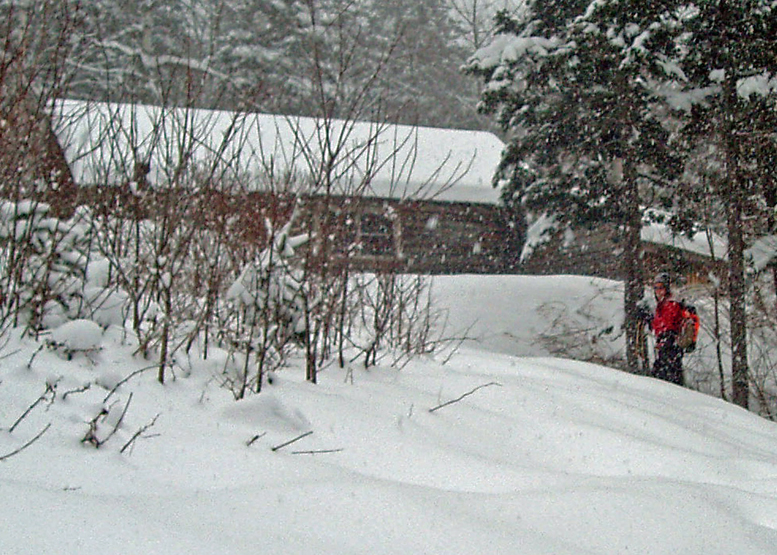
Last year, however, the AMC stopped providing firewood at the High Cabin, so four of us ventured to the Black Mountain Cabin, on the White Mountain National Forest in Jackson, New Hampshire. There, our meticulous planning didn’t go quite as well. We’d assumed that firewood supply would be the major problem and we solved that handily. But we’d never imagined a woefully inadequate woodstove. We still had a wonderful time, but we decided to stay only one night instead of the two we’d planned.
This year our adventure is scheduled for the Sunday, Monday and Tuesday after Christmas, and we’re off to explore “Nenorod,” one of seven cabins ($60-$80/night) at Merck Forest (802 394-7836) in Rupert, Vermont, right on the New York border.
We’ve never been there, never seen the place, which means we need to ask a lot of questions and do a lot of planning to make sure we are comfortable and safe (remember the four rules?). We have to plan on snow, ice and cold.
The website provides a brief description of the cabin and a summer-oriented checklist but it left many questions unanswered. So we asked . . .
One of our main questions was about firewood and the wood stove. After all the warmth of the woodstove after a long day outdoors is the main reason for renting a winter cabin.
The nice folks at Merck Forest were quick to answer. It turns out there’s plenty of the former and, apparently, a very adequate woodstove to burn it in. All we need to worry about is kindling, which isn’t supplied. So we’ll bring a Sven saw and a Gerber hatchet which should solve the kindling issue (neither saw nor axe is supplied at the cabin).
Can you imagine arriving at a cold cabin and not being able to start a fire for lack of kindling? We’ll have plenty of clothing and winter sleeping bags so safety isn’t an issue. But comfort is . . .
Remember, snow, ice and cold changes everything, and if you want to be comfortable and safe outdoors in the winter, you need to plan a Winter Adventure more carefully
How To Plan A Winter Adventure: Making a list, Checking It Twice
Setting off for an unfamiliar destination in the winter is always a bit of a leap into the unknown. All you can do is ask as many questions as you can, learn as much as you can, and go on past experience in similar situations. If you don’t have experience to draw on, do your first adventure in a class situation such as the programs offered at the AMC New Hampshire Chapter’s Winter Workshops (www.amc-nh.org). Either that or try camping out in your own back yard or someplace else with an easy escape route if something goes wrong.
The website told us that the cabin is about 2.5 miles from the parking area. But by asking questions we learned that there are a couple of very steep sections of trail, so we’re better off with snowshoes than skis on this trek.
The website told us there’s no convenient, safe water supply for this cabin in the winter—so we’ll bring a filter and plenty of containers and hike to the nearest water supply. Only people who have never done it think it’s easy to melt enough snow for a winter water supply (though icicles hanging off a cabin rood are fair game . . .)
We also asked about cabin equipment and now know to bring our own mattresses, sleeping bags cooking gear, camp chairs, lights, and that very critical item: toilet paper for the outhouse.
We’ve got the clothing we need to be warm in extreme weather, and the proven gear that’ll keep us safe and comfortable. We’ve got good backpacks to carry most of it in and we’ll be testing a nifty new pulk from Norway for some And we’ve got a list to make the gear, clothing and food we need gets into the backpacks and the pulk so we have it when we need it.
How To Plan A Winter Adventure: Think Microclimate
One of the more useful tools for planning any winter adventure is the NOAA Snow Depth Map. It’ll give you some clue about what you are likely to encounter anywhere you go out to play.
But it doesn’t tell the whole story. For example, we had a BIG snowstorm yesterday. The snow depth map for today has my house squarely in a broad band of 4- to 6 inches of snow. Drive a few miles from my house and that’s absolutely accurate. But my house is on top of a hill, in the wind shadow of a higher hill, and I shoveled 13 inches of new snow off my deck and walkways last night. Even after settling overnight, there’s still 10 inches of snow everywhere I measured.
Just something to pay attention to—snowdepths can change rapidly over a few miles—or even a few feet and you need to be prepared to handle the worst you encounter.